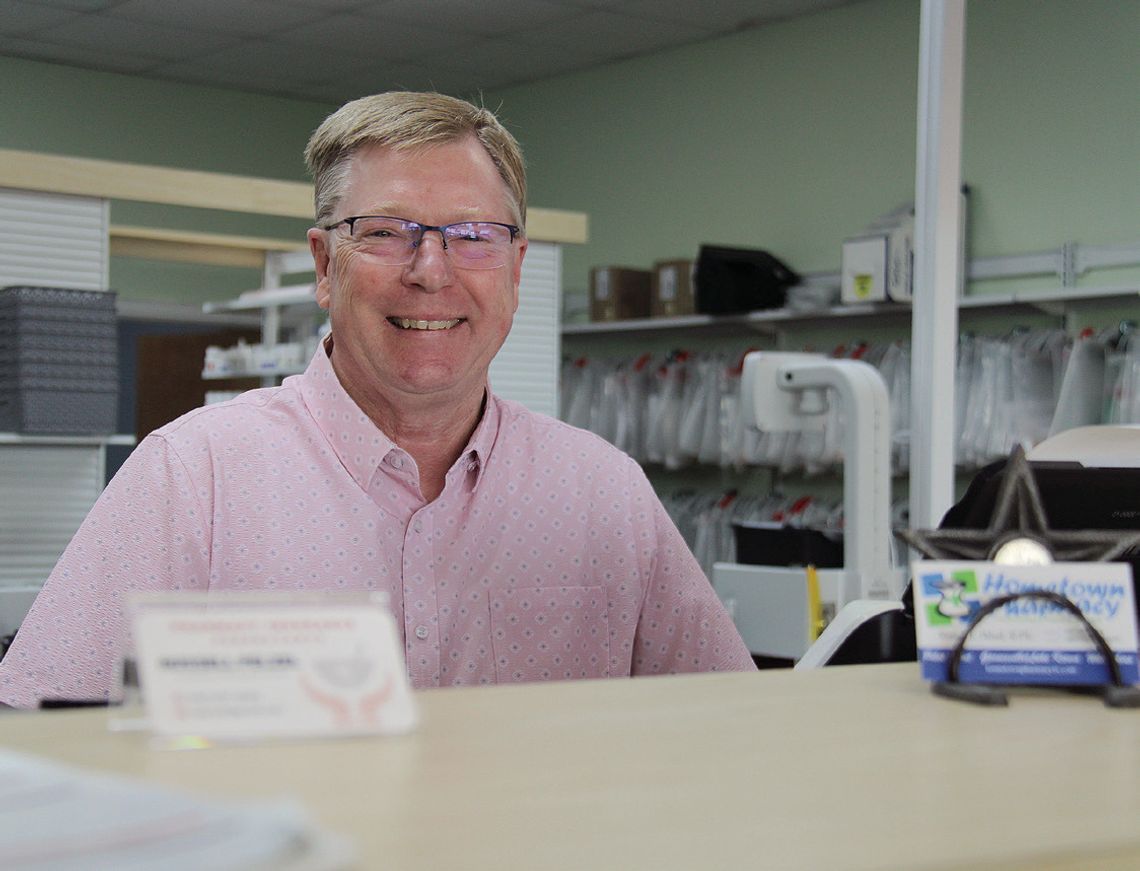
As Russell Pelzel grew up in Pilot Point, there were a couple of men he looked up to who influenced the course of his life.
One, Dr. Allen Groff was always there, no matter the circumstances for the community.
“I kind of wanted to be a doctor originally, but Dr. Groff at the time was one busy little dude,” Pelzel said. “He was everywhere when we were kids.”
The other, Dan Gist, worked hand in hand with Dr. Groff to ensure the community members had the medicine they needed.
“People would call [Dr. Groff] in the middle of the night, and then he would call Dan, and then Dan would come down and get you some medicine,” Pelzel said.
As he watched the pair work, Pelzel decided that he wanted to make his career in the pharmacy world.
Gist served as his mentor, helping him understand the ins and outs of serving his customers with thorough care and precision.
“Dan was very well respected in this community, was involved in a lot of things, and that’s how I got there,” Pelzel said. “And then Dan was kind enough to kind of guide me along early on.”
For almost 19 years, Pelzel has been a pharmacist for his community, with Hometown Pharmacy, supporting not only his customers, but also local school fundraisers and other ways of giving back to the community as a small business owner.
Hometown pharmacist pushes to make big difference
“It was a big deal for me to come home,” he said. “It’s what I wanted to do when I started. It didn’t look like it was going to happen at one point.”
His mentor, Gist, had wanted to sell Pelzel his store, but he “had to turn it down.”
“Then God created a different path for me, and it worked out in the end,” he said.
Pelzel also spoke highly of the doctors who send orders to his pharmacy while acknowledging that with doctors having minimal training on possible drug interactions, pharmacists play a key role in keeping community members safe.
“Our job is to protect the physician and the patient,” Pelzel said. “Things happen, and our job is to catch it before it gets out the door.”
Pelzel doesn’t just focus on serving the community in those tangible ways, but also by fighting for fair drug prices in Washington D.C.
With seniors being the main customers of the pharmacy, there are several federal regulations in place regarding how pharmacies operate.
“It’s been fairly difficult with that process with the politicians, of course,” Pelzel said. “Last year we had a bill that was all queued up that would have taken care of some of the problems that we’re seeing,” he said. “It was a first step. ... I guess evidently one text from Mr. [Elon] Musk kind of killed that bill.”
One of the major concerns is the impact of pharmacy benefit managers, which serve as a middleman between pharmacies and drug companies.
“PBMs were established in the 1960s to help insurers control prescription drug spending and manage benefits,” according to the American Medical Association’s website, ama-assn.org. “Consolidation and vertical integration in the PBM market have raised concerns about the potential for reduced competition and higher prescription drug prices.”
They, Pelzel said, are charging more for their intermediary work between the insurance companies, drug manufacturers and the pharmacies.
“Three companies control over 80% of the lives in the United States,” he said, adding that those three are Express Scripts, Optum RX and CVS Caremark.
The payouts to small, independent pharmacies tend to be less than it is when paid out to larger companies.
“They don’t even pay us the cost of the drug,” Pelzel said. “... You do have to have a product that’s covered and paid for. I have to make a little profit to afford to pay people.”
Pelzel is pushing for transparency from the PBMs regarding the contracts they prepare for the pharmacies.
“If you get a contract from a PBM, there’s no transparency,” Pelzel said. “To the point that I’m really not even supposed to show it to my lawyer, because of the way it’s written.”
The contracts with PBMs also tend to be a take-it-or-leave-it proposal.
A lot of the business with PBMs are also transitioning to mail-order pharmacies, which doesn’t necessarily save customers money.
“To me, they offered a contract 5.5% below cost with the thought that, ‘Oh, well, you’ll sell more. You’ll have plenty of customers come in. They’ll buy something else,’” Pelzel said.
However, if the prescription costs increase, customers must make choices on what they spend their money on— their medicine or the extras in the store.
The PBMs will work with manufacturers to arrange for rebates that increase the price of medicine, paired with fees and delayed reimbursements to pharmacists for the medicines they sell.
“If you’re a cash patient, you’re funding a higher rate, because they have forced the drug price to go up, because that company has to make money, too,” Pelzel said. “So, the transparency thing is just a big deal for all of us.”
The impact and risk to the pharmacy industry is real, with “a pharmacy of some sort go out of business every day ... in the state of Texas.”
Pelzel plans to do whatever he can to keep serving Pilot Point and the surrounding communities.
“We’d like for you to be down here and let us take care of you, because I am certain I’m going to do a better job than anybody else,” Pelzel said.