
The building in downtown Pilot Point commonly known as “Big Red” will be turned into a restaurant, thanks to council approval at the April 23 City Council meeting.
The resolution authorized City Manager Britt Lusk to enter into an economic incentive agreement between the city and Matt Saba to develop the property at 100 W. Main St.
“I will say, and not trying to put words in his mouth, he’s not here, but he’s very excited about this project and is very, very motivated to get it going,” Lusk said.
Big Red was built in 1892 and served many businesses over the decades.
The city purchased the property in 2024 and began seeking a tenant in 2025.
In recent months, complaints about safety have increased because of the building’s deteriorating condition.
The agreement states that Saba has until Jan. 1, 2027, to start construction and until Jan. 1, 2029, to get a Certificate of Occupancy.
He will be responsible for the renovations and upkeep of the building.
Also at the meeting, council discussed submitting a grant application to the Motor Vehicle Crime Prevention Authority for financial support to install Flock Safety camera systems.
The grant aligns with the city’s comprehensive master plan “to implement a citywide smart security camera network at key public spaces, intersections and commercial areas,” Chief Financial Officer Michele Sanchez said.
The cameras operate as license plate readers, which Sanchez noted could aid police officers by tracking vehicles and reducing crime.
Several of the surrounding cities’ police departments use Flock, including Aubrey, Krugerville, Providence Village and Celina.
The Texas Department of Public Safety also began installing 1,800 cameras statewide, Sanchez added.
The data is encrypted, and the information would remain in the system for 30 days unless needed for an investigation.
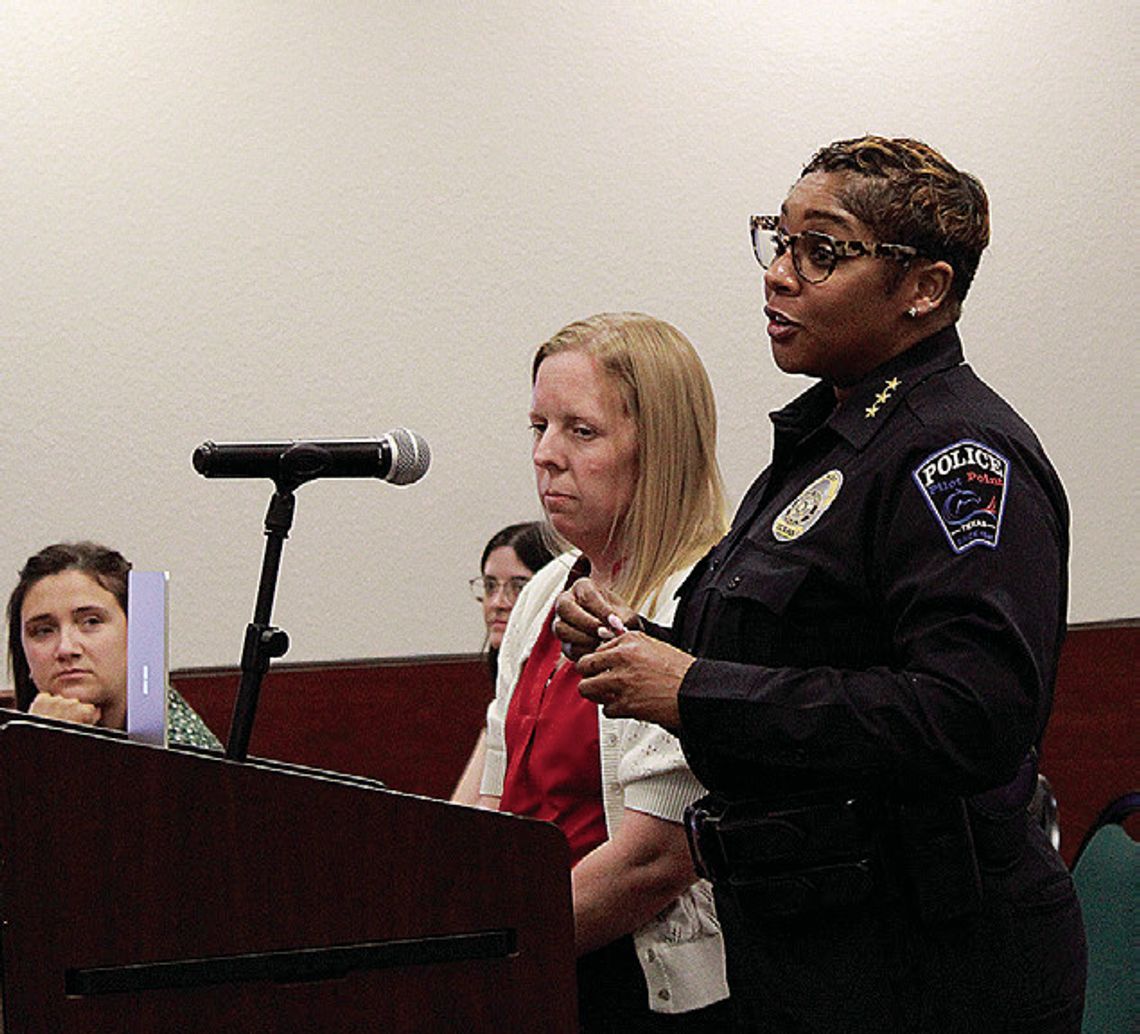
Additionally, the data will not be stored nationally; it can only be accessed by the city’s police department, Police Chief Angela Mathews said.
“If your car gets stolen and they put out an AMBER Alert saying that we’re on the lookout for this vehicle, then everybody’s going to be on alert, and it’s going to be inputted into the system where all officers are going to be alerted to it,” Mathews said. “… If that vehicle comes through our city, we are going to get an alert on that—even if it’s in the neighboring cities—because we can share that data.”
The city would pay $5,400 to match the 20% grant to install nine cameras.
The board approved the agenda item to apply for the grant, 5-1, with City Council member Mike Wilson voting no.
The Council voted to amend the General Provisions Boards and Commissions section, to resplit the Main Street Advisory and Historical Review boards.
“I can admit when I was wrong,” Lusk said. “In 2021, when I suggested we do this, I thought it was a genius idea, and it was going to be more efficient with staff time and our board time. And it turns out that it was probably not a great idea at the time.”
Having a historical preservation commission could qualify the city to become a certified local government.
By becoming a certified local government, the city would receive state funding to support a range of projects, for instance, educational programs and training.
“Most importantly, it would give us a specific board for the certificates of appropriateness,” Lusk said. “We’re proposing with this ordinance that the board would live within the community services departments, and our building offi cial would become our historic preservation officer as well and would be the staff liaison to the board.”
The two boards will be included in the future board appointment application.
The council also discussed appointing a subcommittee at the next council meeting.
Also at the meeting, the council decided who should represent it on the Upper Trinity Regional Water District Board of Directors.
That body was created to plan and manage water and wastewater services in Denton County and a couple of neighboring counties.
Allen McCracken, who serves as treasurer, recently submitted and rescinded his resignation.
Board members serve for four years, and at any point, a council can replace or remove its representative from the board.
Mayor Chad Major read a statement, nominating Lusk for the position.
“He is uniquely committed to what is best for our city, our strategy for responsible growth, and staying ahead of the infrastructure needs to match that growth without outside or conflicting interest,” Major said. “... That’s my personal recommendation, that we put somebody that knows more about what we’re doing, where we’re headed, in place.”
Major also credited Lusk’s with his ability to maintain strong professional relationships, involvement with the public works department and responsibility for the city’s CCN water supply.
“I’m replacing or wanting to replace or appoint somebody that is my friend, and I want to thank him,” Major said. “He has done an excellent job and represented Pilot Point in extreme ways from his knowledge of water. But from my perspective, we need to put somebody on that board that knows all of our business past and forward and will give us the advantage of being able to, as we grow, to put us in a position that will be favorable for our citizens.”
The vote passed 4-2 to remove McCracken from the board and install Lusk, with council members Brian Murrell and Wilson voting no.
McCracken’s term ends on May 31, and Lusk’s term will begin on June 1.
Also at the meeting, council also approved publishing notice about its plan to issue Certificates of Obligation.