Property owners, families connected to cemetery discuss access solutions
Families tied to the freedman community from the Denton and Pilot Point area took the chance to visit the graves of their ancestors on Saturday morning at the St. John's Cemetery.
The site is surrounded by private land off of Hub Clark Road, and access to the cemetery has been a point of contention between property owners and the descendants of the people interred there.
'I think God's smiling on us because we're doing this, and it's important,' Willie Hudspeth said. 'But there's no fanfare. There's nobody out here. There's no high-power politician or a governing body. Doesn't matter. It's us, and ... I'm going to be empowered because of this get-together.'
Up to 2024, Denton County had maintained the property, but the Commissioners Court voted that year to discontinue grounds maintenance, with Commissioner Ryan Williams saying the county did not fund maintenance of any other cemetery as the reason.
'Just please be careful when you're walking through,' UNT Professor Jessica Luther Rummel said before the group entered the grounds. '... The general rules are, if you can't see the ground directly where you're placing your feet, try not to place your feet there. ... You don't want to fall. Also, be very careful. This is an area that doesn't get a lot of traffic, so there are creatures and critters and all kinds of fun things. There is some poison ivy.'
'Yeah, watch for ticks, too,' property owner Sam Stinchcomb added.
Since 2024, fallen leaves have created a soft layer of detritus throughout the cemetery that masks flat and fallen grave markers, and areas of the 1.5-acre cemetery have been washed out, threatening a section of graves.
'You can see the ground changes,' Luther Rummel said. 'You get a lot of erosion.'
She has led a research project about the St. John's Cemetery.
The site began as a slave cemetery on the Bonner plantation that was purchased by the freedman community of the St. John's Baptist Church in the 1890s.
Some of the grave markers that were previously upright have toppled, which can cause the stone to warp and risks the structural integrity of the memorials; others have been buried by debris.
'Because it's been sitting in the dirt, it's going to be so [degraded], but even if we tried to pick it up and put it on the base, it would just be at risk of falling again and causing more harm,' Luther Rummel said.
Members of the Black community, spearheaded by elders such as Hudspeth and Pearlie Mae Simpson, want to work with the property owners whose land surrounds the cemetery so they can care for the graves of their ancestors and of so many other unknown souls.
Bonnie White's late husband, Pastor John White, had a love for genealogy that included a passion for the St. John's Cemetery.
'Sometimes we, as Black folks, we don't know the things about our families, but John was very adamant about that,' she said later in the day.
While by the graves, Mary Helen Jackson came over to Bonnie and asked, 'Did you see Mr. White over there?'
Bonnie told her she snapped a picture of his grave marker.
'You got a picture this time, so if he moved, you know he was out here,' Jackson said.
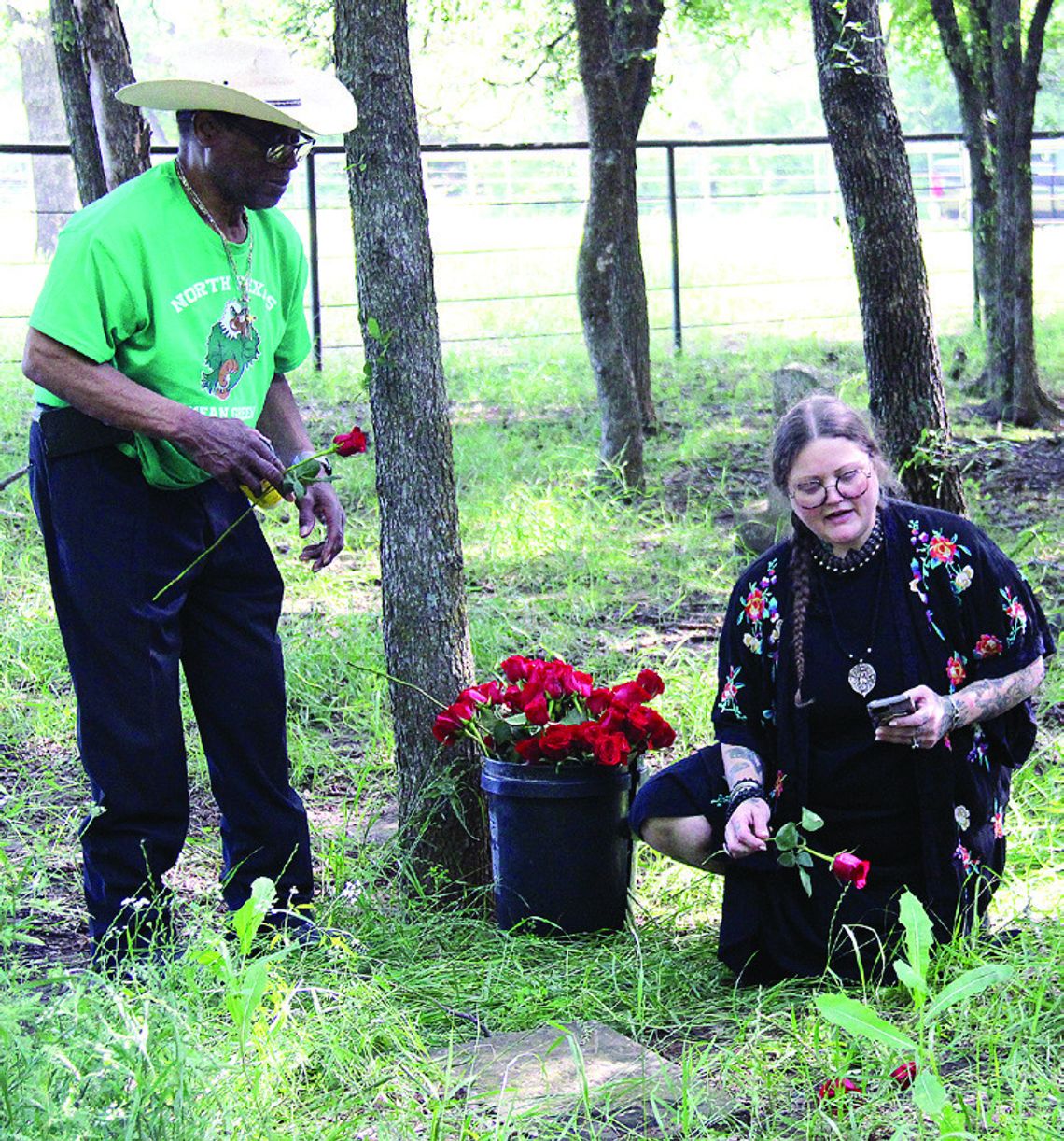
After about an hour of allowing people to explore on their own to attempt to locate their relatives' graves, Luther Rummel gathered the group together to honor the known and unknown dead with a name ceremony.
She read the names as Hudspeth handed her a red rose in honor of each known individual, with the remainder honoring the unmarked graves.
'I'm going to leave these last three roses, we'll say one for all the other children, ... one for all of those who were laid to rest here while still enslaved that never got to see the success of their folk who came back and built something wonderful, and one for all the other freed folks buried here who took claim of this space and made it something for themselves and for their community, just like we're going to do.'
The families said they want to work with the property owners, who expressed concerns about constant access to the spot leading to inappropriate or dangerous activity because of the remote location of the cemetery.
'I'm going to talk to my brother and say, 'What can we do to make this right?'' Hudspeth said. '... That's what this hallowed ground will represent for a lot of people in the future when we're allowed to come out here and just sit.'
Following the work and ceremony at the cemetery, the group was invited to attend a presentation at the St. James's Baptist Church in Pilot Point.
'Those individuals are silent and they can't speak for themselves, and so therefore, I just deem it necessary for me to have something to say concerning those that are buried there,' Bonnie said.