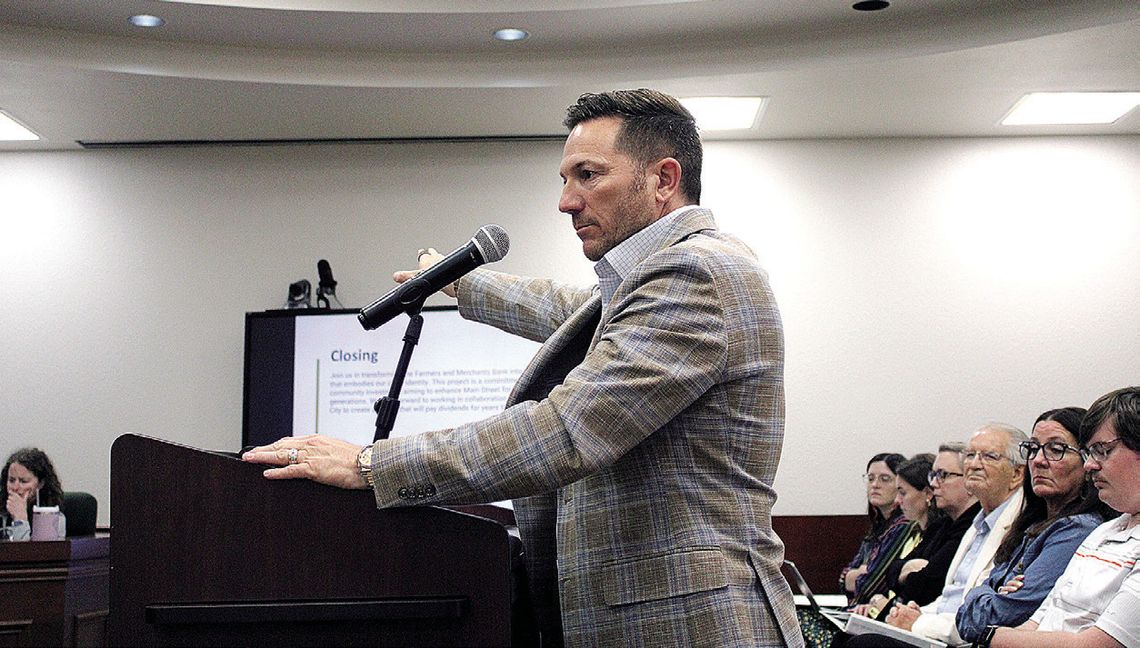
Owners of the Farmers and Merchants Bank hosted a presentation detailing the restoration of the historic building at the May 14 council meeting in Pilot Point that led to unanimous council approval.
Nathan and Shannon Brown, along with their team, spoke about their restoration plans for the 130-plus-year-old building at 100 N. Washington St.
“We see this as an opportunity to do the project correctly, meaning take a building that has a lot of significance historically to the community, and investing in areas that make sure it's being done the correct way,” team member Matt Milhauser said.
One of the most discussed features is a members-only speakeasy, The Vault.
Nathan stated that the basement was originally about 2,000 feet and has since been extended to about 6,500 feet, and that restoring the back wall was set to be completed soon to make it structurally sound.
The Vault is the only membership- based area, Brown said.
Council member Mike Wilson expressed support for the restoration but raised concerns about using public funds for a private club.
Nathan said there will be days when it is open for a nonmembers night.
“For the liquor license that's being provided, there are ramifications the TABC puts in place in regards to memberships,” Brown said. “So that has to be taken into consideration as well. So as a result of that, even for those nights that are open to the public, they will get a membership and obviously to participate, and that's to be in compliance with the TABC as well.”
He added that membership is not based on earning.
“The membership is based on different levels of participation, so, as an example, there will be a liquor locker membership, right, which obviously grants them a right to a liquor locker,” Nathan said. “You're more than welcome to take one. They'll have your name on it, and that is your liquor locker, your own piece of real estate in, obviously, the vault. There will be non-liquor locker memberships, people that aren't interested in the liquor locker, and so on.”
Other features include a cigar lounge and courtyard for events and live music, three boutique hotel rooms, a restaurant and a retail space.
The timeline from the start of construction to obtaining the certificate of occupancy for the different spaces is projected to take 1824 months.
'We believe that we can hold true to that timeline, even with some contingency in there as it relates to unexpected things that could happen as well,” Nathan Brown said.
The total project cost is estimated at $2-$3 million, and job creation is roughly estimated as at least 35-45.
The projected number of annual visitors is between 8,000 and 10,000.
The annual gross revenue is estimated at around $1.4 to $2 million, which Milhauser explained should bring the city about $145,000 to $195,000 in annual tax revenue.
City Chief Financial Officer Michele Sanchez provided further details about the city’s involvement in the project.
She shared that the total incentive package is valued at $360,000 that includes waiver of building permit fees.
“There's also a portion of it that's built on a refund of [hotel occupancy tax] taxes that are paid towards the micro- boutique hotels,” Sanchez said. “So you come into a hotel, you pay a 14% hotel occupancy tax, 7% of that goes to the state and 7% comes to the city. They'll be refunded 100% of those HOT funds that are generated with the city's 7% for five years or a dollar value, whichever comes first. And then the rest of it is a cash incentive that's based on different portions of the buildings being opened.”
She added that there are cash incentives when the certificates of occupancy are issued for the vault, restaurant or rental space.
“After the restaurant is open for one year, they'll get an incentive Year 2, Year 3, Year 4 and Year 5, and then we're done,” Sanchez said. “So, if this is a lot of performance- based incentive, if … portions of the building don't open or renovations don't occur, restorations don't occur, … there's no incentive to be given.”
She added that the buildout will be factored into the budget for the next several years and also explained the impact on property taxes.
“Since it's a commercial building, but it's a restoration, not a renovation, you can only capture 20% of additional value every year over year on the property,” Sanchez said. “So, the property is not going to go from value what it is now to $6 million overnight because there's a cap on that in state statutes, so eventually it will get to that value, but it is going to take time to climb up to that because of the 20% cap on increased value. That's why there is not a refund for property taxes built within this incentive agreement.”
In 2022, Pilot Point was approved for $5 million from Denton County to fund road projects that would be used for the purchase of right-ofway, environmental studies and designs.
The council’s priority was the Massey Road extension to West Walcott Street.
Additionally, the council approved for the “mayor to sign a letter of support for the City of Pilot Point to apply for the 2026 Safe Street and Roads for All (SS4A) Implementation Grant,” as stated in the agenda.
Also at the meeting, council members Brian Heitzman and Ray Dane were sworn in again, resuming their positions on the council, and the council unanimously re-appointed Andrew Ambrosio as the mayor pro tem.