Go to main contentsGo to main menu
Thursday, May 28, 2026 at 11:07 AM

Lions find new home

Lions find new home
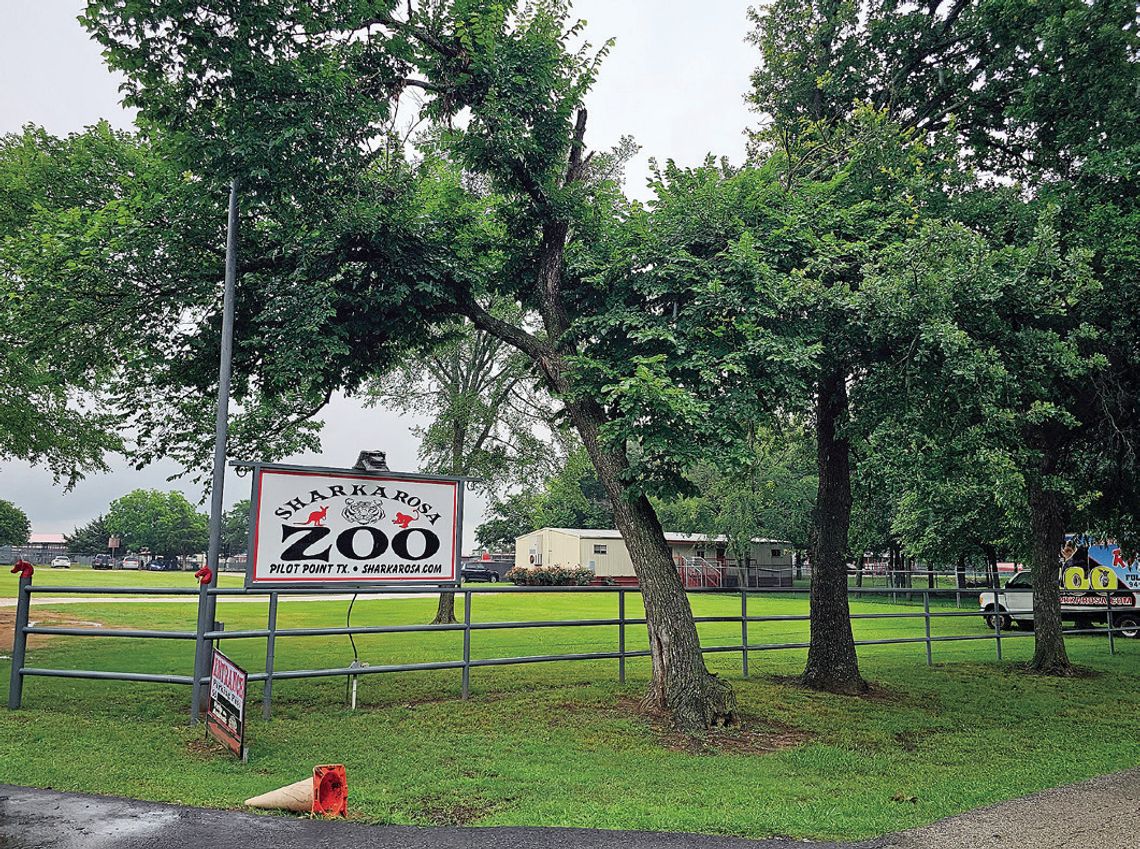
Sharkarosa Zoo sits tucked into the trees along Massey Road in Pilot Point. The facility has been the subject of a recent USDA inspection and complaints by the Animal Legal Defense Fund that resulted in the zoo turning over two white lions to a North Texas animal sanctuary. Abigail Bardwell/The Post-Signal

Two white lions formerly at Sharkarosa Zoo have drawn lot of attention and now live at a new facility.

The animals were the subject of a focused inspection on April 9 by the United States Department of Agriculture Animal and Plant Health Inspection Service.

“We rescued these guys as cubs when they were little tiny cubs,” Shakarosa Manager Brandon Wornick said in a video posted May 20 by the facility on its social media pages. “They had been sick. We have this documented from the zoo they came from.”

The two white lions, Kali and Nzuri, have at least some inbred DNA, Wornick explained in the video.

“Anybody that’s visited us before knows that Nzuri and Kali have had issues for a long time,” Wornick said. “It’s nothing new.”

As cubs, Wornick said, “they had poor coordination [and] couldn’t walk in straight lines,” leading their vets to think they were blind.

“We believe every animal deserves a chance at life, no matter what your disability is,” he said.

Wornick also said the issues with coordination and other neurological symptoms continued to develop over the six years they had the lions, which was attributed to “a neurological condition that stemmed back to the symptoms they showed as cubs.”

Wornick also questioned why the USDA did not reach out to the diagnosing vet about the lions, Dr. Lynn Stucky, in the video Sharkarosa posted.

Among other comments Ronald Richardson attributed to Sharkarosa’s owner, Scott Edwards, in the official report was a comment of “If USDA ever comes back, they had bet- ter bring a gun.”

Wornick confirmed in the video from Sharkarosa that Edwards made a comment along those lines, saying it was “then bring a gun.”

“When someone questions your integrity, calls you and your staff liars, it can be a bit emotional,” Wornick said. “Was this the right answer? No, probably not. But in the heat of the moment, that’s what came to his mind, because he didn’t know how else to tell this guy to please leave our property. … It wasn’t meant as a threat, but as a confirmation to Dr. Richardson that we didn’t want him specifically to be here. It had nothing to do with the USDA. It had to do with him.”

The USDA followed up for an inspection and exit interview on April 13, with Richardson accompanied by Veterinary Medical Officer Michael Tygart.

“No non-compliant items identified during this inspection,” the inspection report reads.

On April 28, the Animal Legal Defense Fund filed a complaint with the USDA in regard to the lions.

The Animal Legal Defense Fund sent a followup email to the USDA on May 15, in which it listed concerns about additional animals, specifically a binturong, a zebra, the sloths, the bobcats, the Kunekune pig, a blue and gold macaw, a hyena and a white tiger based on the observations of “Drs. Monica Bando and Valerie Johnson, two veterinarians with extensive training and experience with both captive wildlife and domestic species, on April 26, 2026,” according to the email.

The ALDF also called “for the USDA to immediately suspend Edwards’ AWA license,” and to take additional legal action against Edwards.

By May 8, the Sharkarosa staff opted to release the lions into the care of a Global Federation of Animal Sanctuaries facility, In-Sync Exotics Wildlife Rescue and Educational Center, after the ALDF posted footage of the lions.

“We decided to move the lions after the harassment that we received, and the reason we did this was to protect the lions,” Wornick said, citing concerns about activists.

Vicky Keahey, the founder and president of In-Sync, and In-Sync veterinarian Dr. Stephanie LaGrone posted a video as well, explaining their perspective on the exchange and what they had determined about the lions’ condition.

“Right now, they’re being housed in our veterinary clinic,” Keahey said. “That’s so that we can get to them and administer the medications and treatments and stuff that they need.”

The enclosure they are planned to inhabit, she said, is 11,000 square feet.

“The cats would not be able to get to the fence or get into a position where we could give them their medication,” Keahey said.

She also added that the cats coming to her facility was not a rescue situation, but a surrender instead.

“Scott called me,” she said. “He asked for help because he knew that we would be able to help the lions get better medical care than he had knowledge of. He didn’t know what was wrong with them. He couldn’t figure out what was wrong with them. He called us to bring the lions here so that we could take care of them, we could diagnose them and we could try to fix what their issues are.”

LaGrone showed video of the lions from when they were in the care of the original breeder as well as from Sharkarosa around the time the lions came to that facility.

She also said the records do not give a full picture of what could have been done for the lions’ care.

“Since they’ve been here, we’ve done a couple of diagnostic tests,” La-Grone said. “They had a good deworming protocol; we didn’t find any intestinal parasites in these girls, there [were] no worms, no worm larvae, anything like that.”

In-Sync’s testing did find the presence of a protozoan parasite called toxoplasmosis, “but that’s not a parasite that you’re going to find on a routine fecal examination,” LaGrone said. “It lives in the nervous- system tissue, so the only way you can diagnose this would be by doing bloodwork or by doing a spinal tap,” she said.

Finding that parasite and what In-Sync said was a critically low Vitamin A deficiency in the lions required additional bloodwork beyond the basic panels that they did not find on a record of being performed at Sharkarosa.

“There’s a lot of micronutrients that these animals need, and if they’re just eating protein, they’re not getting any of that,” LaGrone said.

Vitamin A deficiency causes skull thickening, she added, which increases cranial pressure and “will cause the very back part of the brain, called the cerebellum, to push out.”

“This pressure on the cerebellum, the pressure on the spinal cord causes coordination issues, it causes stargazing, it causes weakness in all four limbs,” LaGrone said. “It will eventually start causing issues with their vision and their ability to swallow.”

The neurological problems are a “100% reversable issue” with proper nutrition, LaGrone said.

Keahey added that they have successfully rehabilitated two lions with similar physical ailments from Vitamin A deficiency before Kali and Nzuri.

“The uncertainty with these girls comes from the chronicity of their issue,” LaGrone said, with Keahey adding, “because they’ve had it so long.”

Time will tell, La-Grone said.

“If they aren’t showing the improvement that we’re expecting, then the next steps is we’re going to take them to get MRIs done,” she added. “… We’re not just going to give up on them. We’re going to exhaust every resource that we can before making any sort of decision like that.”

Keahey said the goal was not to damage Edwards or Sharkarosa in any of the information they have released about Kali and Nzuri.

In the Sharkarosa video, Wornick spoke about the diagnoses In-Sync publicized.

“We did not know about a Vitamin A deficiency, nor do we know if this is 100% true or not,” he said. “But we didn’t know about it because we did our bloodwork in October. It didn’t show a Vitamin A deficiency. We actually provide a carnivore supplement that provides Vitamin A in their food.”

He acknowledged that such a deficiency “might help their symptoms a little bit.”

“But that’s definitely not the root cause of their issue,” Wornick said.


Share
Rate

E-EDITION
Deadlines Changing
Pixie Set