Go to main contentsGo to main menu
Monday, August 24, 2026 at 10:56 PM

Pilot Point works on water infrastructure

Pilot Point works on water infrastructure
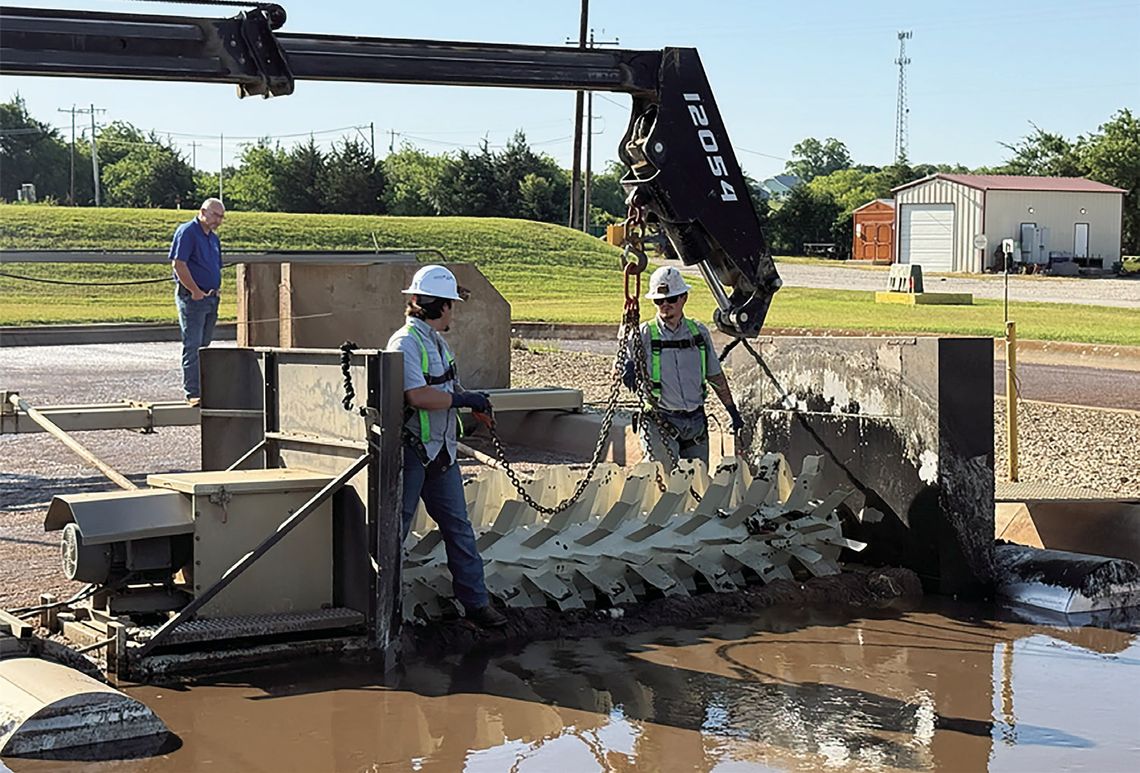
Assistant Public Works Director Michael Cordell watches as Wastewater Plant Technician Israel Gutierrez and Wastewater Collections Technician Peyton Ratliff work to replace the wastewater racetrack rotor. Photo Courtesy of the city of Pilot Point

The Pilot Point Water and Wastewater Infrastructure Master Plan serves as a guide for both existing and future developments.

As the city continues to grow, City Manager Britt Lusk and Public Works Director Nestor Ramirez both shared how the city plans to meet increasing water demand.

“The Water and Wastewater Master Plan does provide provisions for an increase of demand that means more houses, more businesses,” Ramirez said. “It has designated areas for either selection of new wells, and, in that case, as a future provision for a potential transition eventually for other sources of water. And in that case, it's just having some redundancy embedded in the system to have multiple sources instead of just relying on a single one.”

In-depth planning helps ensure the city draws from the right areas.

“Those well locations are based on a hydrogeological study that we've done to make sure what our groundwater and what the aquifers look like and where the best positions for them to be without interfering with each other,” Lusk added.

The city averages about 1.1 million gallons of water use per day, and the aquifers have a set rate to keep them sustainable and to prevent them from draining too fast, Ramirez said.

“That elevated storage tank at Burks will be the equivalent of how much water is … used every day,” Ramirez said. “Because that tank holds 1 million gallons. … It fluctuates if it gets [hotter], but that's basically the usage, and that is our backup.”

One of the biggest issues that the city faces regarding water and wastewater projects is funding.

“Upgrades always come before the income,” Lusk said. “So we try to make development pay for the development and the upgrades, and those impact everybody, and we do that through impact fees, but we don't collect the impact fees until they get the permits. The infrastructure typically has to be in place before that. … And so, working through that, we will try to maintain our rates as normal.”

Although it’s still early in the city’s budgeting process, he reiterated that the city does not plan to increase rates; however, if they do increase, it would not be because of new growth but rather to maintain reliable service.

“It's just all a balancing act that you're trying to serve new customers while maintaining reliable service and the same rates for the existing customers, without having to cause burden on the existing customers as it is now,” Ramirez said.

Some of the reasons for increased costs for residents could be related to equipment, materials, tools, salaries and staff.

“We're not asking current residents to pay for the growth,” Lusk said. “However, the growth has an impact on the current residents because it does help us improve our services and our reliability. … The new development is actually helping fund some of the infrastructure needs for the existing and helping increase the reliability. It's important just to know that it's not happening in a vacuum.”

During a City Council meeting earlier this year, city leaders proposed a future conversation on data centers to better prepare the city, should the issue arise.

Lusk shared that, at this time, no centers are planned in Pilot Point.

“Do we believe that we have the water to give a data center unlimited water usage?” Lusk said. “No. So does that automatically say no to a data center? No. So there are so many different caveats and so many things that we have to explore. We're not taking any positions on data centers at this time, but we want to be able to start having that conversation for when it does come up.”

Being prepared makes sense because of the land in the area that could be developed for such purposes, Ramirez said.

“There's a lot of available land that could be entertained and attractive for those types of businesses, and in that case, it's just a matter of being prepared if that comes into place as do we have the resources, the infrastructure to service those without causing strain on the existing customer,” Ramirez added. “That's the part of keeping balance as best as possible.”

There are a few new projects in the works including the wastewater treatment plant, which is on the verge of breaking ground.

“We have been having several discussions with the CMAR contractor that we've got, with our engineers and with the Texas Water Development Board,” Lusk said.

The project, which has been long in the works, is getting closer to becoming a reality.

“We're on the final [steps] of making sure that everything's compliant so we can move safely towards construction,” Ramirez said.

Once that project begins, residents will start to see more construction equipment around St. James Road.

“Infrastructure-wise, most of everything that we're doing right now is going to be in the ground, and it's going to be pipe replacement,” Lusk said. “So, for the average resident, they're not going to see a difference. They'll just have increased reliability because it'll be newer infrastructure.”

Lusk shared how the city plans on financing some of these projects.

“We've been working with the Texas Water Development Board on the wastewater treatment plant now for about four years,” Lusk said. “… We've applied for another grant in the amount of about $10 million through the Texas Water Development Board, and that was through their newest project.”

The Water Supply and Infrastructure Grants funding program came about during the 89th Legislative Session when House Bill 500 was passed, granting the Texas Water Development Board $1.038 billion to fund water supply and infrastructure projects for Texas communities.

“ A big thank you to Wall Engineering because with all their help, we were able to submit all the information for the WSIG grant,” Ramirez said. “… And we were able, just because of the dedicated effort from the staff to make sure that we have all the documentation, preparation for reporting, financial status, and that we have our water loss report and our required documentation, basically in no time. So, in that case, we were able to just successfully and immediately apply for those grants.”

Once the funds are distributed by Aug. 31, 2027, these TWDB grant funds will no longer be available.

The city is also using impact fees and public-private partnerships as funding sources.

“It takes time for planning, calculating and ensuring that you are meeting demand, you are meeting some of the future demand, but also not overly exaggerating on the use of funds,” Ramirez said.

Lusk shared that the city is proud to maintain a superior water rating, and that residents can track the Consumer Confidence Report, which is included with water bills annually and posted on the city’s website.

“We're very proud of the work that our water and wastewater crews do,” Lusk said.


Share
Rate

E-EDITION
Deadlines Changing
Pixie Set