
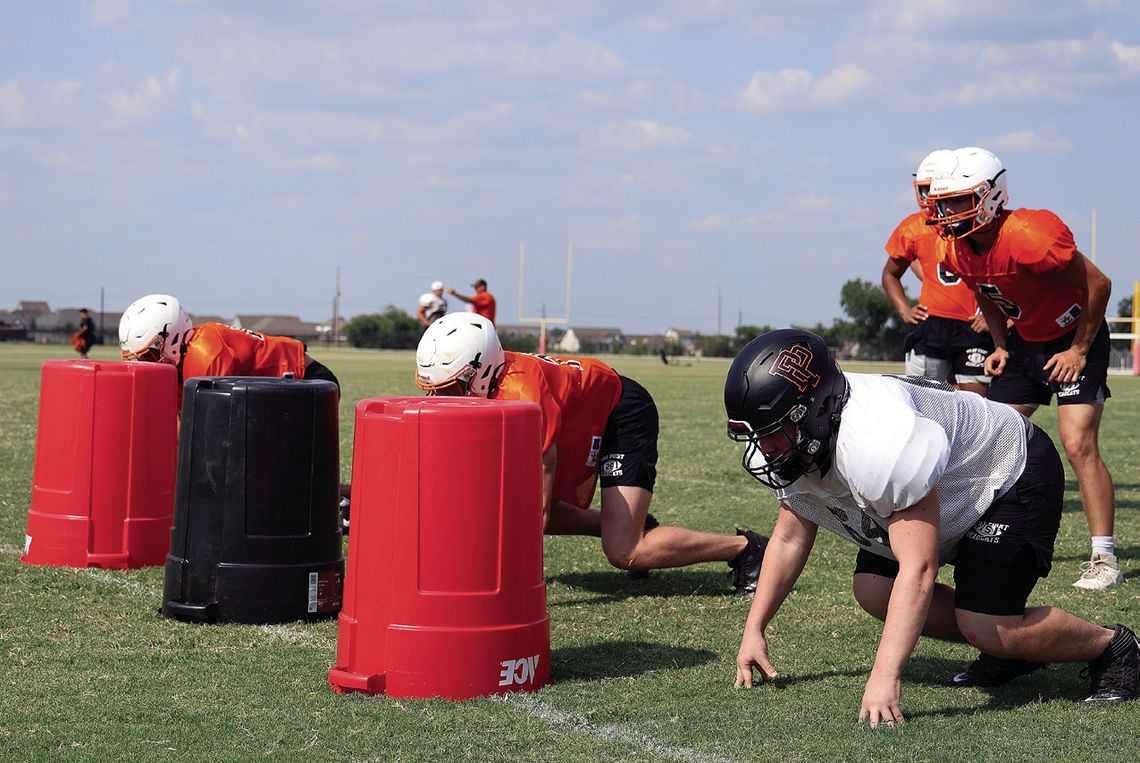
Afternoon practices in summer heat have been a staple of early-season football and marching bands in Texas for decades, but a recent University Interscholastic League mandate could change how schools approach their preparation process.
The UIL Legislative Council recently released their 2026-2027 Heat Stress & Athletic Participation Required Plan, mandating that all member schools use wet bulb globe temperature guidelines starting Aug. 1.
“Following three years of recommending the use of Wet Bulb Globe Temperature guidelines, the UIL Medical Advisory Committee recommended that these protocols become required standards,” according to UILTexas.org. “The recommendation was based upon continuing medical research, accepted national best practices, and ongoing evaluation of heat-related safety measures.”

WBGT goes beyond ambient temperature measurements, using three thermometers to calculate the effects of temperature, wind speed, solar radiation and relative humidity to determine heat stress limits.
Introduced by the American College of Sports Medicine, the WBGT guidelines include modifications to activity, including length of practice, hydration breaks, rest ratios and what equipment is worn, at specified WBGT levels to prevent heat-related illnesses.
The UIL’s Heat Plan states that schools must use a scientifically approved instrument that measures WBGT or internet-based weather station software to track wet bulb globe temperature.
If using an instrument on site, the instrument should be set up in the vicinity of where the physical activity will occur 30 minutes prior to the start and should be read 15 minutes before the start of the activity and should be checked every 30 minutes afterwards.
The UIL Heat Plan mandates each school to have an emergency action plan to handle heat-related emergencies, including an onsite rapid cooling station that allows for full-body immersion, such as tubs or tarps that can be filled with ice and water, for each outdoor athletic activity.
The plan also advises coaches and directors to promote unrestricted access to water at all times and states that rest breaks must involve unlimited hydration intake and rest with no physical activity involved.
Keith Ivy, Aubrey ISD athletic director and head football coach, said the writing had been on the wall for the recent mandate.
“We knew when [the UIL] made this a recommendation a couple years ago that this was on the horizon,” he said. “… There are some adjustments everyone is going to have to make, but we’re blessed here in Aubrey that we just finished our indoor complex, which is going to give us the option to get in there on days that we need to avoid the heat.”
Aubrey’s director of bands, Jason Noyes, said in the past the marching band would practice in the cafeteria or gym when it was too hot to do so outside, but Aubrey’s new indoor facility helps alleviate that problem.
“It’s a huge resource for us, so we really appreciate our school district and those who voted for the bond for it because it's going to be a game changer for us with the weather, and we’ll be able to practice on a field that’s marked like a football field,” he said.
Ivy added that he’s happy to see the safety of the student athletes and band members is a high priority but said there could be some more changes to athletic schedules as programs shift activities and start time or location to avoid the afternoon heat.
“We’re doing everything in the mornings now, but when school starts next week, we’re probably not going to be outside for the first few weeks unless it cools off enough, and that’s unlikely,” he said. “I don’t know how a lot of high schools are going to handle it. Pilot Point, Sanger, Krum and Ponder, to name a few, don’t have indoor facilities, so it's going to be even more of a challenge for them.”
Chad Worrell, Pilot Point ISD athletic director and head football coach, echoed Ivy’s sentiments on the changes.
“It’s a little stressful to be honest,” he said. “Morning workouts are a limited option for us because we start school earlier now going to a four-day week. The schools that have invested in indoor facilities have a huge advantage because they don’t have to worry about [the heat] as much, but we want to protect the kids first and foremost, so we have several different plans, and we’re going to make it work.”
Pilot Point’s director of bands, Daniel Balkema, said the Bearcats have already been doing what they can to work within the WBGT guidelines.
“We’ve been practicing outside in the morning when it isn’t as hot during summer camps, between 8 a.m. and 11 a.m., and the rest of our two-a-days are inside the school,” he said. “… We have canopies that provide shade to our rest area, and we’ve been giving plenty of shaded breaks and have been passing out iced towels during the hottest part of our rehearsals. The safety of our kids is very important to us.”