A trip to texashistory.unt. edu can turn into a dive into a rabbit hole.
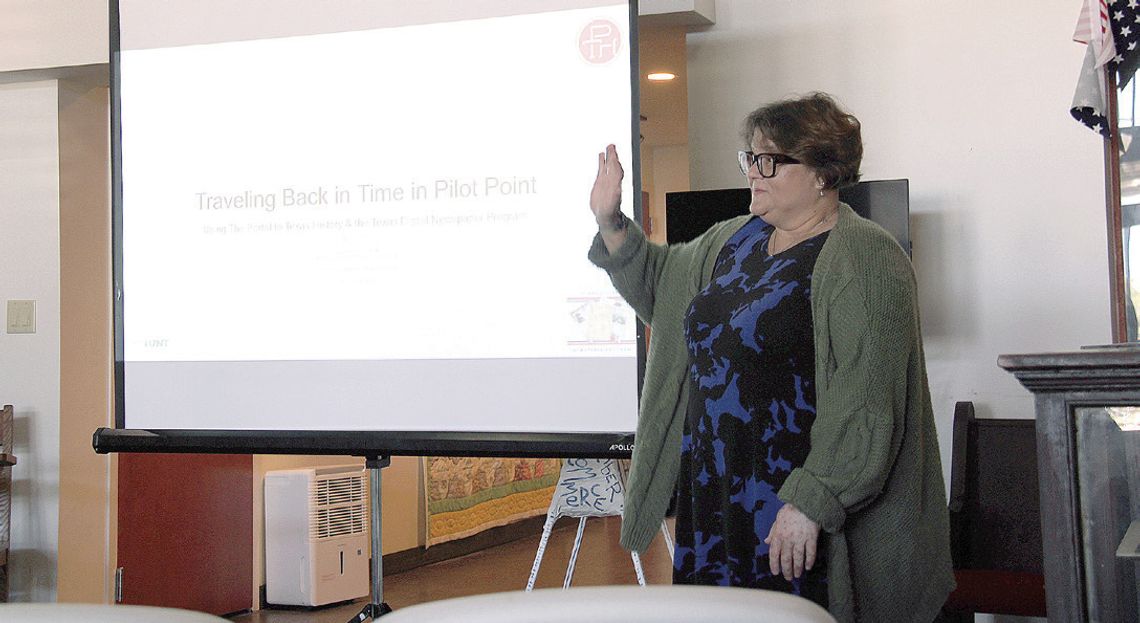
That's part of the message Ana Krahmer, the director of the Digital Newspaper Unit at the University of North Texas, shared on Saturday morning in Pilot Point.
'[We're] working with 13 million newspaper pages,' she said. '... If you've ever done any kind of library research, you know that going through that number of materials is difficult, and you have to know how to search through it.'
Krahmer worked in cooperation with the Post-Signal and Pilot Point Community Library Director Jenna Glass to preserve and digitize the records of the Post-Signal's archives from 1967 to the mid-2010s.
Several tools and filters on the Portal to Texas History help narrow the search to increase the likelihood that a search will be successful, whether that's on the newspaper side or the side that documents other forms of the historical record, such as pictures, books, letters and diaries.
A basic search is a good place to start, Krahmer said, which can be for a name or event.
' A proximity search is where ... [the] search reads the lines in a newspaper,' Krahmer said.
An example of that being used was to search for the names of two streets that intersect to find instances where a house may have been mentioned in the paper.
'This is especially helpful when you are looking for life events—births, weddings, anything like that, historical events,' Krahmer said.
She also explained what a guidance search can do.
'You can use guidance search to add a date range and then to remove words in other places,' Krahmer said. '... The idea is mixing and matching your terms so that you're saying 'I need this, but I don't need this.'' Krahmer also told the attendees about the Chronicling America project, which UNT contributes to as well.
Sorting by location is helpful for finding the papers from Pilot Point, Krahmer added.
'By the way, Pilot Point's newspaper title changed a lot, very often,' she said. 'And when you're a librarian—if you all know about catalogers— they're very specific and very detail-oriented.'
They won't group papers with 'a completely different title' together, even when it's a continuous publication, she added.
'They put an equal sign in their name from 1930 to 1950,' Krahmer said. 'Therefore, it's a totally different title.'
New batches of the archives will continue to become accessible on the portal, so Krahmer encouraged people to check back again if at first they can't find the issues they're looking for.
Although it took a grant for the libraries to work together to preserve a large chunk of Post-Signal archives, it is possible for individuals to contribute copies they have to the UNT library system to be scanned and returned.
Anyone interested in sharing issues of the Post-Signal can bring their copies to the paper office at 111 E. Main St. in Pilot Point for the paper staff to facilitate that process or they can be taken directly to Willis Library at UNT.